
Conversation
On writing poetry as a fiction writer


I am not really a poet, and by that I mean that as far back as college or probably high school, I have lumped myself in with the fiction folks, the people who want to write stories and novels. But I’ve also always written poems. I wrote rhyming ones in elementary school, with extended metaphors about leaves and the sea, or sing-songy bits about a hyperbolic bad day, mimicking Shel Silverstein. I liked feeling out the rhythm of a line and matching it to the next, though I had no idea about meter. In high school, I made moody, interior attempts at free verse. My junior year of college, I took a poetry writing class against my will—I wanted to enroll in yet another fiction workshop, but couldn’t manage it with my schedule, so there I was, stuck in poetry instead. But I ended up loving writing in another genre and trying out its forms. Villanelles, ghazals, sonnets. I was taken by ekphrastic poetry, especially—we went to the art museum on campus, and I wrote little pieces about the body, stemming from paintings and sculptures, some of which worked their way back into my prose.
When I graduated, I moved to eastern Washington and started my first job as a teacher. I wrote poems with desert imagery interwined with musical instruments. I tried to work on my first novel. But poems were easier to fit into the day, so for the first time in my memory, I read a full-length poetry collection outside of class—Sharon Olds. And I wrote, when I had time, on the back of grocery lists, on lesson plans, wherever.
But if you asked me, I would say: I wrote poems as an exercise. The way a musician plays scales. Or, perhaps, an etude, a piece of music which literally means “study” and was made for the purpose of practicing technique. I told people that I wrote poems to tune my attention to language and image—I hoped, when I returned to prose, that my writing would be a little sharper.
So from the beginning, the poems I wrote were in a kind of artistic conversation: conversation with the other kinds of writing I was doing. Sometimes in a very direct way: In a few pieces of writing, I picked up the poems whole and tried to place them inside a story, or else they became a conscious source for a character’s voice. Most of the time, though, the connection was something I couldn’t trace. Writing poetry helped me with fiction, and not just technically. I thought through ideas in poems that found their home in a story later on, which maybe itself was just working out an idea for a later piece too.
This is conversation, but a very closed-off conversation, entirely within a single person.
The poems kept some of the writing conversation inside myself varied, but it could still get a little tired and repetitive in there. Workshop and discussion, talking with other people who write differently than you do and think differently than you do tends to break things open, prompt you into directions you otherwise wouldn’t think to go.
I remember being hungry for this kind of conversation while I was living in Washington. My writing friends from undergrad had tried to convene a remote workshop, but we hadn’t been able to manage it with any kind of regularity—this was the early days of Google Meet (it was called something else then) and none of us had the bandwidth to organize workshop during the school year. So I met, instead, with a group teachers in my grad program one day in Portland to talk about poetry.
Why poetry, I don’t know, except that it was the only thing everyone was interested in. A lot of us were teaching it at the time, I think. We went to a restaurant called Cha Cha Cha and got margaritas and sat and shared, not our own writing, but favorite poems that we’d read. Just once, but enough to make me think: I can find people and ask them to do this.
I was quiet and awkward and not in the habit of asking people to do much of anything. But in the following years I became comfortable inviting people I’d just met to join writing groups or share writing. The husband of a classmate. My soon-to-be housemate. People on pilgrimages in Kentucky and Spain. Friends of friends. Coworkers.
Because it was a mix of people, the genres were many. Short stories and novels and poetry and plays and memoir and essays. When we had nothing to share, when we didn’t want to prompt one another anymore, we picked a book to read and talked about craft and then tried to mimic the choices that felt interesting or strange to us.
The conversation was broad and shifting. Sometimes we were many, and sometimes we were only three. But how easy it was to invite in another voice, just by letting someone suggest a writer the others had yet to read, and allowing that to open us up.
Community
When I graduated from the MFA and needed a break from the novel, I turned to poetry for a month. I think I learned the most about writing poems just from reading the work of my classmates in those 30 days—and seeing how they responded to one another.
When I wrote my own poems, I often asked my coworkers at the brewery to give me words as a prompt. I’d ask three of them, separately, for a word at the start of a shift, and then turn them over in my head while I was working or draft pieces of the poem by hand if the night was slow.
One night—not a slow night—I had my three words, but no real idea what to do with them, other than an image of peaches in a cellar. I sat down on a couch near the server station once I was cut and forced out a poem in my notebook, then moved over to the bar and typed it up, before calling it good and going home. I remember apologizing as I uploaded it that night: “Sorry for this one.”
It was the first poem that I felt as though I’d really pulled teeth to write, that I hadn’t sat with and let unfold naturally. If it weren’t for the deadline at the end of the day, I wouldn’t have written it at all; if it weren’t for my coworkers, I wouldn’t be forming the lines the way I was, to fit in the words they’d given me. But I was tired, and done, and so when one of my classmates responded to the poem, and did what we always did—found something good in it—his words hit me a little differently. Not because the act surprised me—this is what we were supposed to do; what, as teachers, we were good at doing—but because his comment made me look at the poem and reconsider it myself.
The poem read not so bad to me the next morning. And then a little better, a few days after that. When my coworker asked to see it weeks later, she reacted to it in a way you kind of always hope a reader will. First, seeing what you wrote the way you did, and then mirroring it back to you in another light, with other language. Listening to her, I thought: Maybe I should consider keeping this one.
By the end of the month, I had written a lot of poems this way. Some of them turned out and some of them didn’t. But all of them have this strange extra context of other people and place seeded within them—the words that didn’t come from me and my memory of where they were spoken.
When I went to edit the poem, I thought of taking some of the initial awkwardness out, but I found that I couldn’t. Maybe a better writer would have been able to reimagine it, but I was able to shift only one word—a backward-looking one, memory, for a forward-looking one, hope, phrasing that had more to do with the logic of the poem than anything else. I left everything else and sent it off, as the last poem tacked on to the end of the packet, because it felt a little out of place, still. A week later, I got an email in reply, my first acceptance of the summer—my first in a long time, on a very, very short list of publications. Looking at the response, I thought: How strange, the constellation of people who pulled this poem onto the page. The words that were gifted to me, and the community that held me to a deadline; the first readers who made me see it, and now a stranger-editor who had plucked it out of what I’d thought were better poems ahead of it and said, no, this one.
Encounter
The other site of conversation that has shown up for me, repeatedly, is the kind that punctures the interior life, or that settles in and takes up residence inside and accompanies me for a time.
If you read a poem that resulted from this, you might just call it reference. But I’ve used references in writing before, and those feel different. A reference (in my habit of using them anyway) moves outward—you’re writing, and a circumstance or idea rhymes with something you recall from prior reading, so you reach out and pluck it from the vast repository. Or you go and look up the allusion, and then usher it into the poem.
The encounter I’m thinking of looks like this: You’re at some emotional crux, good or bad, and whether you feel open or not, there’s a small piece of you that remains porous to the world, at least the world of words. It might be—it often is—that you’re not especially capable of expression yourself at the moment, that you are taking things in because you have no words, anymore, for whatever it is you would say if you could. And then, when you are not expecting it, something from the outside slips all the way in.
The ideas and the language swirl around inside, and somewhere between your experience and this swirl of thought, there is a poem.
The other halves of these conversations have never failed to surprise me. In the past year, they’ve included a recorded lecture at the University of Notre Dame in which a Cistercian monk, Bishop Erik Varden, discusses woundedness—opening, strangely, with a song by Gracie Abrams. They’ve begun in one place—an essay I read in advance of starting as a reader for West Trade Review, about the narrator’s encounter with Louise Gluck—and brought me to another: Gluck’s poem, “The Wild Iris.”
Some of the encounters were single phrases. I listened to the introduction to the podcast Turning to the Mystics, and paused when the host James Findlay, in discussing his experiences as an ex-monk, uttered the statement: “Everything real is forever.” Some of the encounters were re-encounters. I reread Mrs. Dalloway in the fall and Ulysses in the spring, and both times they entered me differently than they previously had. Though, strange, I had forgotten: The last time I read Ulysses, it had prompted poems too.
You never really know—what is going to speak to you or how, or whether it might take years for a piece to come back around and intersect with your thought in a way that feels necessary. Why, one moment you’re just listening and reading, and the next, the language cuts right through and meets you. And makes you want to meet it back.
Both/and
When I taught imaginative writing in my final year of the MFA, I asked my students to discuss the role of reading in the creative life of a writer. I thought it would be a pretty straightforward conversation—they were an engaged group of students; many of them had already expressed a love of reading—but the discussion went sideways pretty quickly. Though there were some good defenders of reading—with a lot of nuanced reasons why they thought it was important, beyond just making them better writers—a not-so-small number of the class thought it wasn’t necessary.
I eventually did what I don’t like to do in seminar classes, which is: intervene and make a conclusive statement. The premise of the class depended on us reading, and we would be reading a lot.
There were several things I did wrong in framing the conversation—and also things that changed over the course of the semester, as we actually got into the reading. But when I look back at that first discussion, one of the problems was that it bent towards the transactional: What can a writer get from other writing? The students who argued against reading were reacting like consumers being told what to buy: They could find what they needed elsewhere. And they might not need an outside source at all—they might be sufficient on their own.
I think a lot about what one of my students said near the end of the conversation: That she would question someone who wanted to write but had no desire to read others’ writing. Wouldn’t you want to be part of what you were making?
She was talking about community and encounter in the broadest sense, that when you write and then read what other people are writing, you’re being welcomed into a conversation, even if the writers you read have no idea that you’re speaking back.
I think my students who were resistant to reading assumed that the purpose of reading, as a writer, was to mimic a writer’s style, to try to write like that writer. And while a lot of creative writing discussions do focus on technique—story structure and character development and language and form—reading is also about thinking and feeling, letting a story or poem get under your skin and form how you see things. Even looking at technique is not extractive—you can’t just mine a text for craft, not if it’s truly good, anyway. There’s too much interesting stuff going on in it and in you, that engaging with other writing almost inevitably ends up as conversation. You’re going to put yourself in a piece, whether you plan to or not.
They were right, my dissenting students, that you can encounter new thinking and feeling in places outside of other writing. In an earlier assignment, they’d already brainstormed some of these examples: Music and film and art and comics. But my other student was right too: Don’t you want to be part of what you are making?
In a good conversation, it’s both/and. You want sameness and difference. You want, sometimes, to be affirmed in what you already know, and other times, to be completely shaken out of it.
Part of my turn to poetry, as a fiction writer, I think has been this. Because I find in it both sameness (it’s still the written word) and difference (a formal break with prose).
And perhaps because I’ve grown accustomed to practicing my thoughts in poetry, to first thinking of it as a site of internal study and conversation before I thought of it as anything else, now when I’m at my most open—when I have those chance encounters with others’ language or thought—poetry has become the way my own thinking most often spills out.
Listening
Recently, I came across a poem from my classmate Mary Robles in Scraps, a journal that publishes abandoned pieces alongside reflections from the writer. In the Q&A that followed her poem, Mary says:
Regarding slow work: I think we can all sometimes benefit from writing less and reading more, talking less and listening more, disparaging less and believing in more, dismantling less and assembling more. Imagine how we would change if we all did that?
I’ve felt permission in this, lately, to not write so much. To revise a piece the third or fourth time instead of producing a new one. To remember that when I’m reading or listening, I’m the other half of the conversation, and slow work is happening in that interior space. Things are assembling in there, and they’ll come together, half of my own volition and half in surprise at what I can’t account for.
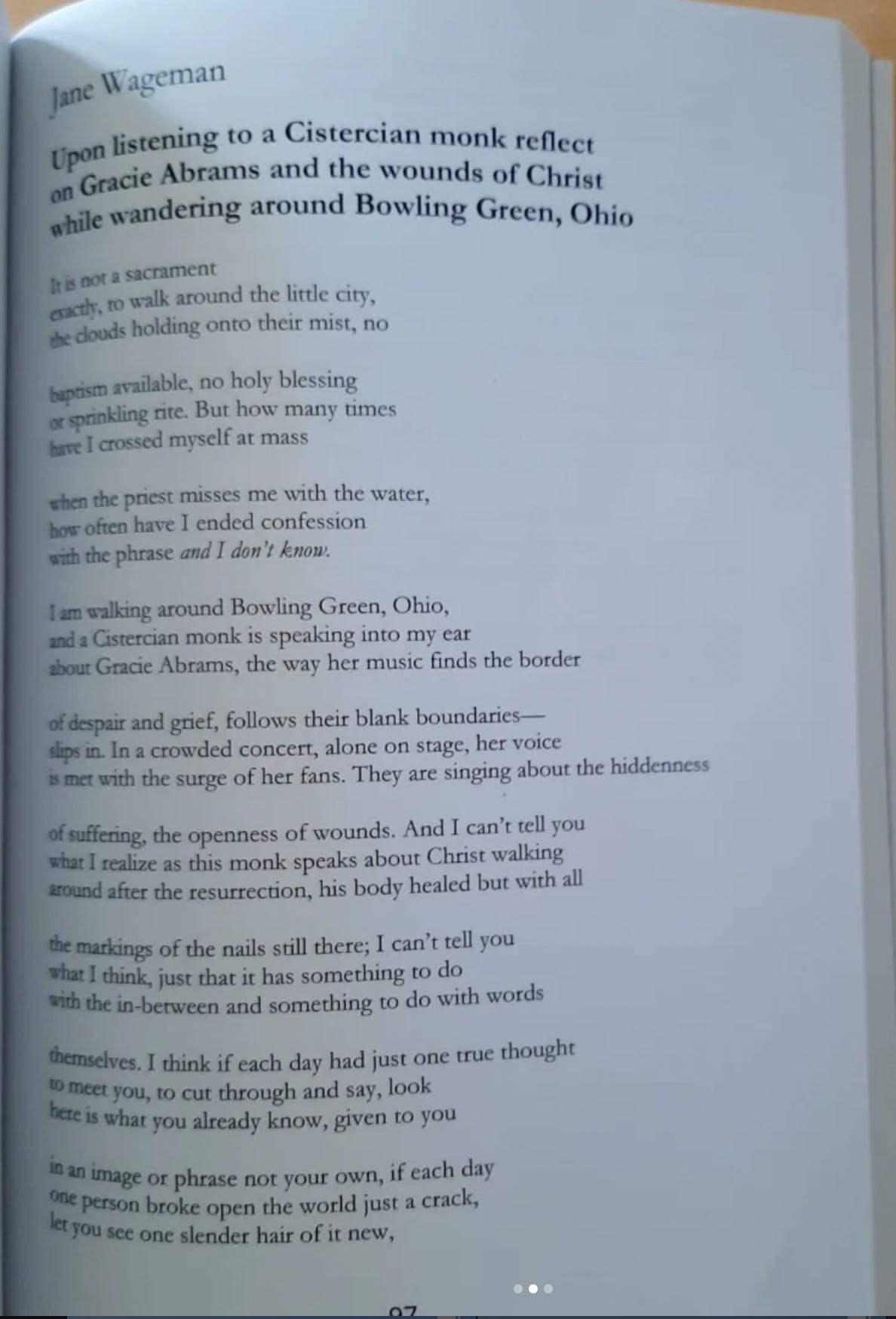
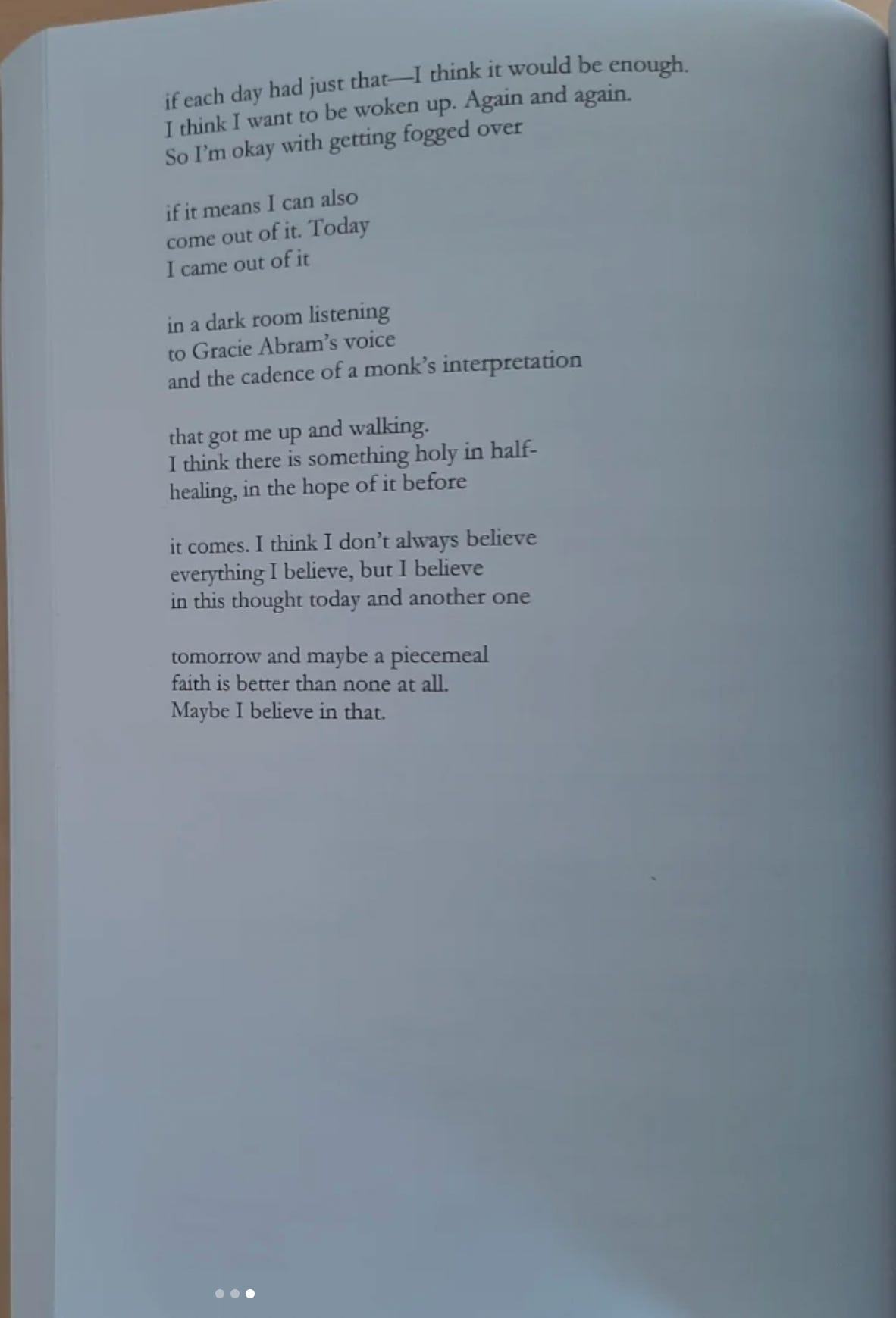
Other poems:
"In a good conversation, it’s both/and. You want sameness and difference. You want, sometimes, to be affirmed in what you already know, and other times, to be completely shaken out of it."
I love this observation! I've had this thought when it comes to literature as a transformative experience. If a book is going to change us, make us see the world differently, it has to meet us in this space of sameness and difference. It has to be different enough to change our perspective, but similar enough to be legible and sympathetic. Which might just be to say: great encounters with books work like great conversations.
“It might be—it often is—that you’re not especially capable of expression yourself at the moment, that you are taking things in because you have no words, anymore, for whatever it is you would say if you could. And then, when you are not expecting it, something from the outside slips all the way in. The ideas and the language swirl around inside, and somewhere between your experience and this swirl of thought, there is a poem.”
Thank you, Jane— this is a really good description of where poems come from!