
Writing and control
A pottery analogy from St. John's

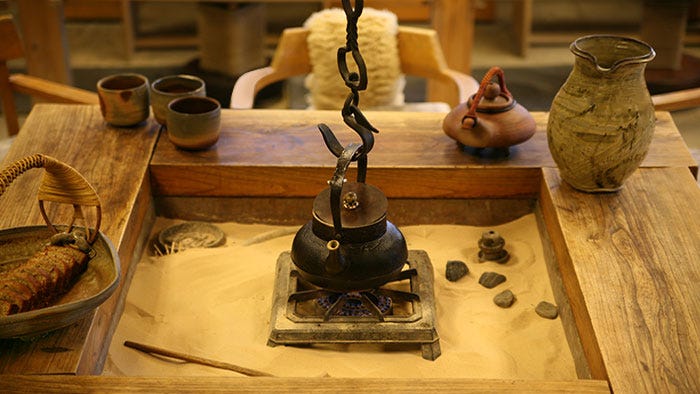
During my week at the Collegeville Institute, I did not make it to prayer or the organ recital or to most of the hiking trails or the adjacent women’s college—all things I wanted to do—but I did make it to the pottery studio on campus one afternoon.
After some conversation and tea around the little stove (pictured above), one of the apprentices showed two of us around the studio. The history of the studio and the process of clay-making and pottery firing were all fascinating, but the part that stayed with me most was a brief comment the apprentice shared at the end, a way of thinking about pottery-making that he said the head potter likes to say on his tours.
The shape that the final piece of pottery takes, he says, depends equally on the clay, the potter, and the kiln. There is a tendency to forget this—for the potter to assume that he or she has complete control, to forget that there are other factors that exert their own influence on the piece.
This was made more real by the details of the tour that had preceded this reflection: the photographs of the large kiln, the shelves of mugs and plates and vessels that varied in texture and color depending upon which part of the kiln they’d been loaded into. The cellar of clay aging in long logs, marked with the date and the different mixture of ingredients each contained. (The photos here give some idea.)
In the analogy, the head potter simplifies, saying that a third of the influence belongs to each component: clay, potter, kiln. The tour supported this idea, but also added complexity to it. I was struck, as the apprentice walked us through each step of the process, how much labor lay behind a single piece. How much time (the clay in the ground, the retrieval of it, the transport) and work (the mixing of the clay, the strainers it passes through, the aging, the shaping, the firing). How many people were involved, not just the potter working on that particular piece.
All of which is to say: In crafting a piece, the craftsman simultaneously exerts control and admits a certain lack of it.
Which of course corresponds so well to writing—though the other controlling forces are not as concrete or easy to identify as the clay or the kiln. Perhaps language and the subconscious are the closest parallels.
But in any case, the central claim in this story—that complete creative control is an illusion—this I believe wholeheartedly.
Even so, I succumb to the illusion of control all the time. Each time I start a novel or short story or essay, I convince myself that this time, with this one, I’ll proceed with some kind of clarity of vision from the start. I have a desire for a smooth, controlled process, one in which the story never proves unwieldy or problematic or excessive. A process that will inevitably include time and revision, but one in which scenes never need to be completely torn down and built up again. One where I know what I’m building as I build it. One where everything goes to plan. Where there is, in fact, a plan of some kind.
And of course that never happens.
George Saunders mentions this lack of control as he reflects on the moment in which writers recognize the gap between what they have written and what they had wanted to write:
This is a big moment for any artist (this moment of combined triumph and disappointment), when we have to decide whether to accept a work of art that we have to admit we weren’t in control of as we made it and of which we’re not entirely sure we approve. It is less, less than we wanted to be, and yet it’s more, too—it’s small and a bit pathetic, judged against the work of the great masters, but there it is, all ours. (108-109)1
He’s speaking in the same vein as the passages I quoted from him last week, in which he noted the desire to make our own writing conform to the writing we idolize. Here, though, the rejection of that idolized style or form entails not just an acceptance of our own idiosyncracies of style and voice, but also an acceptance of our lack of control.
We choose how we write, and we don’t. We choose what to write about, and we don’t. We might start from a place of control—but the weirdness we’d rather keep out likes to find its way in.
There are moments when I find this lack of control beautiful: When sentences have an inexplicable momentum, carrying the prose to places I could never have planned for it to go. When a question within a scene (What would the charaters do if. . .?) or an experiment with form takes the story in a direction that I didn’t anticipate.
I’ve heard others call this a state of flow. It feels to me a bit like a runner’s high. Where you’re in the moment and out of it at once.
But there are also moments when I find the lack of control frustrating. Could I please not have an image of cornfields or cars appear in this next piece? Or Why won’t this narrative fit in a short story—nicely, neatly? Why is it forever splodging out of its container—and not necessarily fitting well into a longer form either?
There are moments, too, when the lack of control is not just frustrating, but daunting: Where on earth is this story going? What is this saying? Do I believe what I’m writing at all?
The first set of questions reads like self-criticism, a resistance to tendencies that probably need to be explored, played around with, accepted and stretched.
The second set of questions can be more paralyzing. I find myself needing to set them aside while I write, to allow for the fact that the story might end in a place I didn’t intend for it to go. That the shape, in the end, might be unusable. That I could write my way through a story and reject it. Like a pot that misfires in a kiln, perhaps, that was formed with good intent but succumbs to some flaw.
I have only the barest understanding of pottery from that short tour at St. John’s, but I have to imagine that there is something kind of awful and wonderful putting so many pieces into that kiln at once and seeing what happens. Waiting for not just weeks but months: “seven weeks of loading the kiln, ten days of firing, two weeks of cooling, a week of unloading and nine months of cleaning.”2 Not knowing, until the end, what will come of them all, these pieces you made but whose final form—the exact streaks and coloring, the texture—retain some uncontrolled mystery within them.
Saunders, George. A Swim in a Pond in the Rain. Random House, 2022.
https://www.saint-johns-pottery.org/about
I loved this pottery tea time analogy, too!