
Small narratives: microfiction
A recap from Winter Wheat, part 2


This is an expanded version of a workshop I gave on prose poetry and microfiction at BGSU’s Winter Wheat Literary Festival earlier this month. The purpose of the literary festival is for writers to generate their own writing; I’ve adapted the workshop to focus on the microfiction rather than the prompts. You can find part 1, on prose poetry, here.
Containment
During my first semester of the MFA, I joked, at one point, that everyone should get their most common feedback from workshop printed on a t-shirt.
Mine, I said, would be, It should be a novel.
I’d turned in three short stories that semester, and for two of them, this comment had come up. Is it really a short story—or is it a novel?
They seemed to be fighting the form.
One faltered and never grew into anything. The other became the novel I’m working on now.
But even when I actually write short stories, I have trouble keeping them short. I began this summer revising a near-40 page one, and the other two I drafted clocked in around 20 and 30.
A story will be however long or short it needs to be, and writing with publishing in mind is the wrong way to write—but anyone trying to publish short stories will tell you that these are not ideal lengths. Around 15 pages is really preferable. Twenty is okay, but getting a bit long. You often can’t find places that will take 30, let alone 40. (I was pretty limited when I started submitting that one, and very glad when it found a home.)
It’s not just about publishing, though. It’s about containment and structure, about the shape of a short story, and how much character and backstory the form will hold.1 Really, a short story is just a different beast than a novel, and the truth is, I don’t think I’ve ever gotten really comfortable with them. Every time I start one, I think I’ll be able to hold back—and I almost never can, mostly because my mind works in novel-like characters, who don’t live well inside the short story form. I blame my sister, for spending too much of our childhood turning every conceivable thing into a character with me: stuffed animals, our brothers’ Hot Wheels cars, photocopied coloring book pages from the post office in our grandparents’ tiny town, our mother’s ceramic Christmas decorations. Once—to be fair, my sister took no part in this one—a blue plastic bead and a Saturn-shaped eraser who lived together in a hollow Hershey Kiss container I’d saved from Valentine’s Day, stashed inside my second-grade desk.
When you’ve spent your formative years turning every object in your life into a character with multiple generations of family, an interior life, and a backstory, the habit has to find somewhere to go.
But a short story is really not the right place for it. Because a good short story is not a novel in miniature. It’s not a piece of a novel, either. It’s something else entirely.
So I knew, when I began the MFA, that I wanted to write a novel, not a short story collection.
It seemed strange, then, that I was simultaneously drawn to flash fiction and microfiction. I was struggling to get my workshop submissions under the 20-page cap—and yet, I was intrigued by the thought that a person could write a story in 1,000 words or even just a few hundred.
Like many programs, BGSU has a reading series, and that fall, a flash fiction writer, Sherrie Flick, came and read some of her work. I’d read a little flash before, but something about her reading captured my interest, and I ended up reading the anthology she edited later that spring.
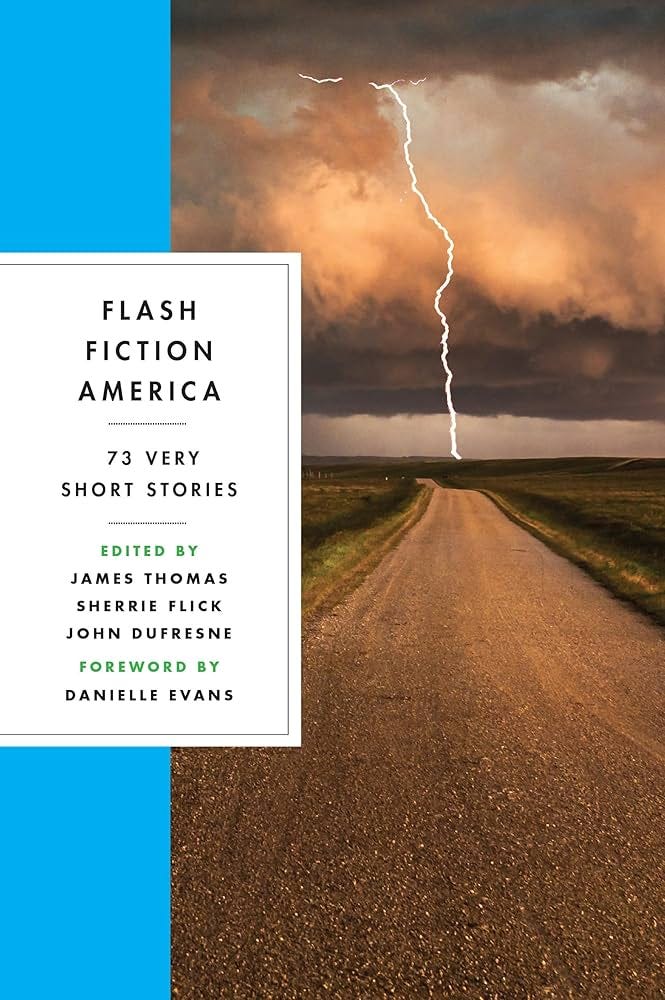
Separately, at the Winter Wheat festival in November, I went to a workshop on microfiction. The exact word count for the genre varies, depending on where you look. Flash fiction is usually under 1,000; microfiction is under 500 or 400 or 300, depending where you look. But in any case: microfiction is very short fiction. In the workshop, we read a piece from 100wordstory.com, which publishes work that is exactly 100 words (no more, no less). We did a prompt where we wrote a piece quickly, based on three words, then tried to cut it down to exactly that size.
It was fun and challenging and different. I realized, in trying to write this kind of piece, that the short form spoke to the narrative part of my brain—the part of me that wanted to be a fiction writer, that was here to work on a novel—but to the dormant, poetry part of me as well. The part that loved language and image and the sound of words. The part that liked thinking about how one sentence moved to the next.
I spent most of my time in the MFA working on the novel, but on occasion, I’d find myself coming back to flash or microfiction, playing with this idea of containment, of keeping a story to a very small space. Of telling a story through suggestion, based on imagery and the implications of a single scene.
Then, last spring, the novel draft finished, the thesis submitted, I set it aside and spent the month of April writing poetry, the month of May writing microfiction.
I think, looking back, that the two of these were more connected than I thought. Poetry and microfiction. They were separated into these two months: two different challenges, two different genres. But the desire to turn to these smaller forms came, in the end, from a similar place.
Microfiction
Microfiction, as a genre, is defined by its length, but there is more to it than that.
In the introduction to Best Small Fictions 2024, which includes both flash and microfiction, editor Amber Sparks notes the following qualities in short fiction:
Compression: “the very-short story writer must take those basic elements of story and crush them down into a very small, dazzling diamond”
Experimentation: “The freedom to spin wild structures is dizzying in a very small space; much like a lab setting, the short-fiction writer can control all the variables, can use test tubes and beakers to make new concoctions”
Attention to language: “in small fictions. . . writers are free—much like poets—to make perfect and delicious each sentence, each word”2
When I started reading more flash and microfiction last year, I found this to be true. My favorite pieces, the ones I was most drawn to, were the ones where the language or the structure or concept (or all three) immediately drew me in, where the narrative was so compressed that I felt as though I somehow got the whole of a story, the entirety of an emotional arc in a few pages or a few paragraphs—or sometimes less than that.
If that sounds close to poetry to you—well. Yes.
And yet, many of these stories were very solidly in the world of prose. They started from the side of fiction. They had dialogue and sometimes character names. They moved through time and focused on scene-setting and arc. The language and the size edged them towards poetry, but it didn’t land them there.
Take, for example, the first microfiction we discussed during my Winter Wheat Workshop: Tania Hershman’s My Mother Was an Upright Piano.
If you haven’t read any microfiction before, I’d recommend taking a minute to read this one. It’s short—as promised—and it shows the compression Sparks is talking about, the attention to language.
In the story, the entire narrative of the parents’ marriage is told through the metaphor of the piano. Not just the relationship between the parents, not just the fact of the mother’s affair—but all of the characterization of the mother and the father and the daughter too.

It’s an evocative metaphor—but an unstable one. “My mother was an upright piano,” the narrator begins, before revealing that “someone else’s Husband. . . turned her into a baby Grand.”
The second statement leaps out of the logic of straight metaphor—because of course pianos don’t actually work like this. An upright piano doesn’t turn into a baby Grand when you play it well; this is an added layer of figurative language.
It’s unclear where this excess comes from, though. Because there’s a layering of perspective too: The mother is relaying the information about her affair, belatedly, to her daughter, who realizes that she knew about her mother’s "maestro,” looking back. And she wonders, now, if she is like her mother—she wonders, at the end of the story, whether she should find someone like this maestro, too.
So whom does this metaphor belong to? The mother or the daughter or both? Is the mother’s transformation real or is it desire? Is it how she was or how she wants to see herself?
An extended metaphor can be clunky, but I don’t find it so here, because it is cased in so many questions. It is, also, a surprising and efficient vehicle of character. We see the mother, but also the father, “the tuner,” who “technically expert, never made her sing.” How quickly, in just that sentence, you know the dynamics of their marriage.
As far as experimentation goes, though, this is a fairly traditional short story: dialogue, characters, narrative arc. It’s impressive, really, how close to a longer short story this microfiction feels. By focusing everything on this single metaphor, Hershman has somehow managed to get all the feeling, all the depth of a longer story into just a few paragraphs.
But microfictions really do take a variety of forms.
The other piece we looked at, Damian Dressick’s Four Hard Facts About Water, is written as a list, directed in the second-person.
As the title suggests, all of the list items are facts about water. Water mixed with whiskey. Water in baptism. Water in the pool at a high school swim meet.

The first three items have no seeming connection to one another. The fourth brings them all into relation:
After your two-year-old daughter trips and falls unseen into the neighbor’s in-ground pool while you are in their summer house trying to find steak sauce, your involvement with Fact One can consume your life, costing you your spouse and job and nearly, if not quite all, your self-esteem. Fact Two will be rendered utterly powerless in the face of this tragedy and Fact Three will come to be the way you define irony—when slurring to strangers who have already asked you once to please leave them alone as closing time approaches at O’Flanagan’s, always a little quicker than you’d like.
Compressed narrative, yes. Like “My Mother Was an Upright Piano,” this one is also centered around a single metaphor, though in this case the water is also literal.
If we picture that genre line again, we might imagine “Four Hard Facts” moving closer to the poetry side of the spectrum by adopting some of the tendencies of “OBIT” and “My Other Girlfriend is a Corvette”: the logic of association, the more ambiguous relationship to time. Because the narrator in the story, like the speaker in the poems, doesn’t seem to be standing at any particular point in time.
He is simultaneously the high schooler competing at the swim meet and the adult man at the bar. He sits there, at the bar, at multiple points in time, drinking casually before his daughter has died and drunkenly after her death has upended his life. He is outside of time too, commenting on the Christians’ attitudes towards baptism with a tone of detachment.
But if the form moves “Four Hard Facts” towards the poetry side of the spectrum, the language keeps it closer to the side of prose. In fact, the individual sentences in “My Mother Was an Upright Piano” have a more poetic cadence than the ones in “Four Hard Facts.” This is not a knock at Dressick’s writing—just a comment on the direct syntax. The presence of both prose and poetry elements shows, I think, the way in which poetry can inform microfiction without shifting it out of the genre. On a granular level, “Four Hard Facts” sounds like fiction, while zooming out, the list and the story’s movements bear some resemblance to poetry.
Directions
Microfiction inclines towards experimentation, as Sparks mentioned. Trying to get a story into such a tight space naturally makes the writing take different forms. So it’s not surprising that some of those forms veer towards poetry—and that others might go in even stranger directions.
What I immediately liked about microfiction, back in May, was that you could commit to a direction and follow it. This is similar to Laura’s point about the containment of prose poetry allowing the writer to take risks: There’s a freedom that comes from adhering to a boundary of some kind. In microfiction, the word count focuses your attention; it makes you close out other possibilities and try to get at the heart of a story in new ways.
The best stories manage to feel both surprising and true at once. And these are the ones that are the most fun to write too. When you land on something that surprises even you—I love that feeling.
Sometimes the surprise is in the language, sometimes the content, sometimes the form.
If you’re inclined towards the experimental, you might end up asking, after you’ve drafted a piece, if what you’ve written is microfiction at all, or whether you’ve crossed into poetry, or whether you’ve landed in some other genre entirely.
In the next post—the last in this series of Winter Wheat recaps—I’ll take up this question of genre boundaries by looking at some publications that purposefully don’t distinguish between poetry and prose for short pieces.
But for now I’ll just say that, in the same way prose poetry allows the poet to draw from prose, microfiction allows the fiction writer to draw from poetry. And in this middle space, the kinds of narratives that open up, though short, often feel far from small.
Novellas are the obvious genre to address here—and, really, that’s probably what the longest of these stories are veering into.
Sparks, Amber, editor. Best Small Fictions 2024. Alternating Current Press, 2024.
The part about turning everything into characters reminded me of the stories we’d make with your nesting dolls—Baby Jo!