
Spiral narratives
Part 2 on stand-up comedy and writing


It is, in the end, appropriate, that this post has been sitting out here, waiting for me to write it for months—though I didn’t intend this structure at all.
I wrote Part 1 in August, when I was staying at my parents’ house in the Twin Cities, between leaving Ohio and starting the residency up in Collegeville. It felt like a kind of empty space to me, that month, like a time that I needed to fill. The entire residency, still hanging in the future before me, seemed like an empty space too. I’d been making lists of ways to structure the time. The monks’ daily prayer schedule. A weekly reading group that I would facilitate in September. Substitute teaching. Hobbies that I could acquire. (Note: I have acquired none. Other than maintaining a sourdough starter while baking no bread.)
I want time, but I’m also a bit fearful of it. Less so now than in my younger years. Repeated encounters with retreat or silence have made them less unfamiliar, more welcoming. I don’t worry as much about what my mind might do with unfilled hours, when I’m lucky enough to have them.
But there are seasons when this becomes intimidating again. Post-concussion, having a vast stretch of time without distraction started to sound less like a gift and more like an imposition.
And so, in August, I gave myself little assignments. Tasks to complete. It might have been the teacher in me, knowing that if I wrote “Part 1” on a post, I was giving myself a “Part 2” due.
But then other things intervened. Some good—my classmates, deciding that they wanted to do a daily exchange of writing. A remote workshop that I needed to finish a story draft for. And some less good—the logistics of moving to another state, which I’d tried to organize well, but were still complicated and confusing when it came to insurance and prescriptions and doctor appointments. Headache-inducing, figuratively and literally.
When I came back to stand-up comedy, it was incidental. I was back home for Thanksgiving, and my mother put on the Great British Bake-Off. It was a holiday special featuring British soap opera stars.
“Remember James Acaster?” I asked her. She did. I’d shown a clip to her and my dad the year before, in which Acaster, a stand-up comedian, fails miserably on the baking show. He later incorporates the bit into his routine.
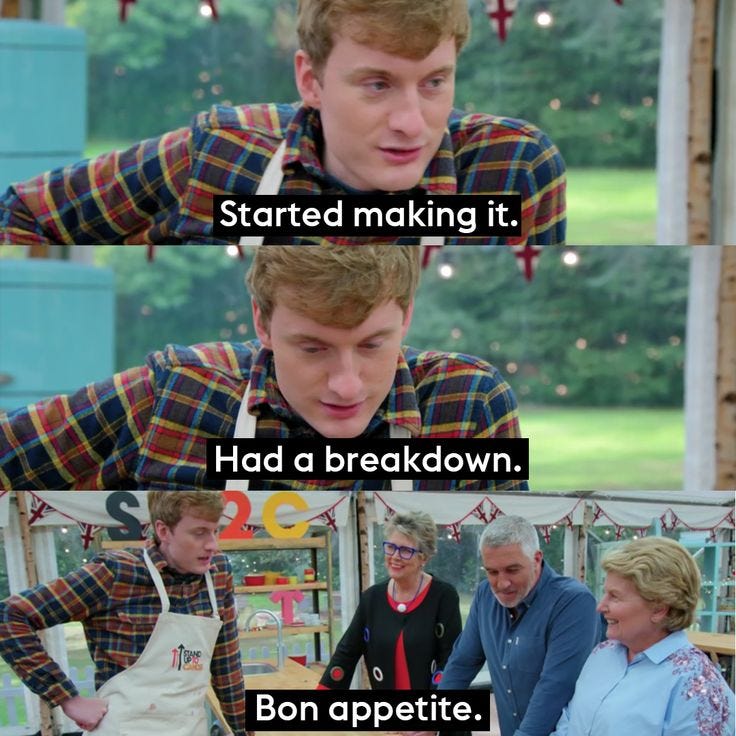
The conversation sent me on a deep-dive through James Acaster clips and, eventually, back to his comedy special Repetoire on Netflix.
This is that structure, I realized, as I watched it. He does it too.
If you tend to watch stand-up comedy, as I often do, on YouTube, in clips, then you miss a major part of the form. The clips isolate the best stand-alone jokes, but what they omit is the construction of the overarching narrative—the way that comics arrange the set as a whole. Some comics are better at this than others, and just as there are different narrative structures in fiction or memoir or other types of writing, so too are there different narrative structures in comedy.
But the one that I like best is shaped like a spiral.
Spirals
Think of it this way: There’s a still point at the middle of the narrative. Like the eye of the storm or the middle of a whirlpool. The story starts there.
Jane Allison, in Meander, Spiral, Explode, describes the spiral structure like this:
A spiral begins at a point and moves onward, not extravagant or lackadaisacal like a meander, but smooth and steady, spinning around and around that central point or a single axis. Obsessing, my mind spirals, spinning through different elaborations of a problem, pulling me deeper and deeper into a vortex until I say enough and take a walk to knock it free. A spiraling narrative could be a helix winding downward—into a character’s soul, or deep into the past—or it might wind upward, around and around to a future. Near repetitions, but moving onward. What gives a spirling narrative a sense of ending? Good question, for spirals could go on forever.1
I will, in a bit, spoil the ending of James Acaster’s sets—sets plural, because Repetoire consists of four separate episodes, filmed on different nights, that ultimately spiral around one another. Because of this, the series is capable of spoilers, not in the manner of giving away a punchline, but by revealing how the pieces ultimately work together—what that spiral is really up to.
Lest that sound decidedly unfunny, here’s a peek into the humor.
This is the still point at the center of the first set, “Recognise”: a story about Acaster being an undercover cop moonlighting as a stand-up comedian.
No jokes are funny in summary, so none of this will be humorous in my telling it here. The delivery is, of course, everything. The lead-in to the cop premise is a simple anecdote about adults asking kids what they want to be when they grow up—and Acaster having the foresight to tell them, as a child, that he wants to be a drug dealer, so as not to prematurely blow his cover.
For the majority of the show, though, you forget this premise. Acaster goes off in any of number of directions, with jokes about conga lines and oven gloves and the enigmatic flavor of Dr. Pepper. With each joke, the narrative swoops out, so that you forget about the whole business of the undercover cop, until he suddenly brings it back.
In fact, if you listen to the jokes in isolation, you can get them without this context at all.
Part of the humor, though, if you watch the whole set, lies in the act of forgetting. The repeated insistence on returning to the most absurd story—the one you know is pure fiction—is, itself, funny.
Still, it all feels somewhat random, right up until the end.
Until the end, the set seems to be following a different structure that Allison describes in her book: the more leisurely meander, whose main impulse is to forestall the ending through a series of digressions. The digression, according to Italo Calvino, is “a multiplying of time within the work, a perpetual evasion or flight. Flight from what? From death of course.”2
And this is what Acaster appears to be doing, in a way, with all these other jokes—wandering away from whatever ending the main narrative with the undercover cop story is headed towards, lengthening the set via these unrelated asides.
Except the asides are not, in the end, unrelated. There’s a gravitational pull back to that central story, a pull that feels, in the beginning, inexplicable, until (slight spoiler number 1), the last few minutes of the set. Suddenly, the “real” context for the fiction of the undercover cop story starts pouring in, so that now, as Acaster talks about the cop in the third person, you can see how he is talking about himself. The cop story has really been about intimacy and recovering from a break-up—and so, in the most humorous and moving and swirling way, the pieces of the set come, suddenly, into focus.
Beginning/end
I’ve buried the lede a little, because there’s an additional element, a false beginning in Acaster’s set. He doesn’t actually begin with the undercover cop business at all, but with a lengthy story about bananas and revenge and Pret a Manger.
If you watched the clip above, you may have noticed two odd details, completely unrelated to the banana story: that Acaster is kneeling during the majority of this bit, and that, when he stands, he touches his watch, pausing mid-story to start a timer.
This is because the story about the banana is not, Acaster has previously established, the real beginning of the set. This is stand-up comedy, and so, if he kneels (as, apparently, some ice skaters did once, to get around the time rules of competition) none of this counts.
And it appears, for a long time into the special, that this is quite true. The story about the banana seems like a random little addendum, with no relation to the rest of the set.
That is, until the very end, when Acaster ties it in, as he kneels at the end and stops his watch again, during an anecdote about “pictures you put your head in”—referring to the cardboard cut-outs that people poke their heads through to snap photos of themselves in the guise of other people. In this case, a cop and a robber. “I’m looking at the cop and the robber,” he says. “I didn’t know where to put my head. I’ve been undercover so long. I don’t know who I am anymore.”
The tightness, then, of the set, makes it more spiral than meander. The spiral is a shape that makes sense for the content too, for Acaster’s fixation on the aftermath of the break-up.
Here’s Allison, again, on a subset of the spiral-shaped narrative, the vortex:
I wonder if first-person retrospective narratives—especially obsessive ones—might naturally follow a vortex. . . A preoccupied (haunted?) narrator turns around and around in her hands the most potent moments of her past, gazing at repeating patterns and shapes as she spins.3
The repetitive nature is part of the spiral. Everything begins to look the same. Everything, when you obsess, can refer back to that center.
In the hands of a comedian, this obsession becomes funny. And—possibly—insightful.
The insight in Acaster’s series lies in the larger pattern—not just the ones he builds within each set, but the ones you, the viewer, begin to notice, if you watch them alongside one another. The next two episodes, though they stand alone, follow a similar pattern: They begin with an addendum (a random outlier, like the banana story, that appears unrelated) before introducing a center that they spiral around. That center, like the undercover cop story, is a fiction that reflects reality: jury duty in episode 2, a witness protection program in episode 3. They both end in a similar fashion: with the revelation of how these fictions reflect reality, and a final incorporation of the previous elements into a culminating bit that is both moving and completely ridiculous.
You do not need to have watched the previous “episode” to understand the subsequent ones. But if you have, you’ll notice that the earlier sets are being woven in too. Slowly, a larger narrative is being built that incorporates the larger fictional elements—the undercover cop story, the jury duty story, the witness protection program story.
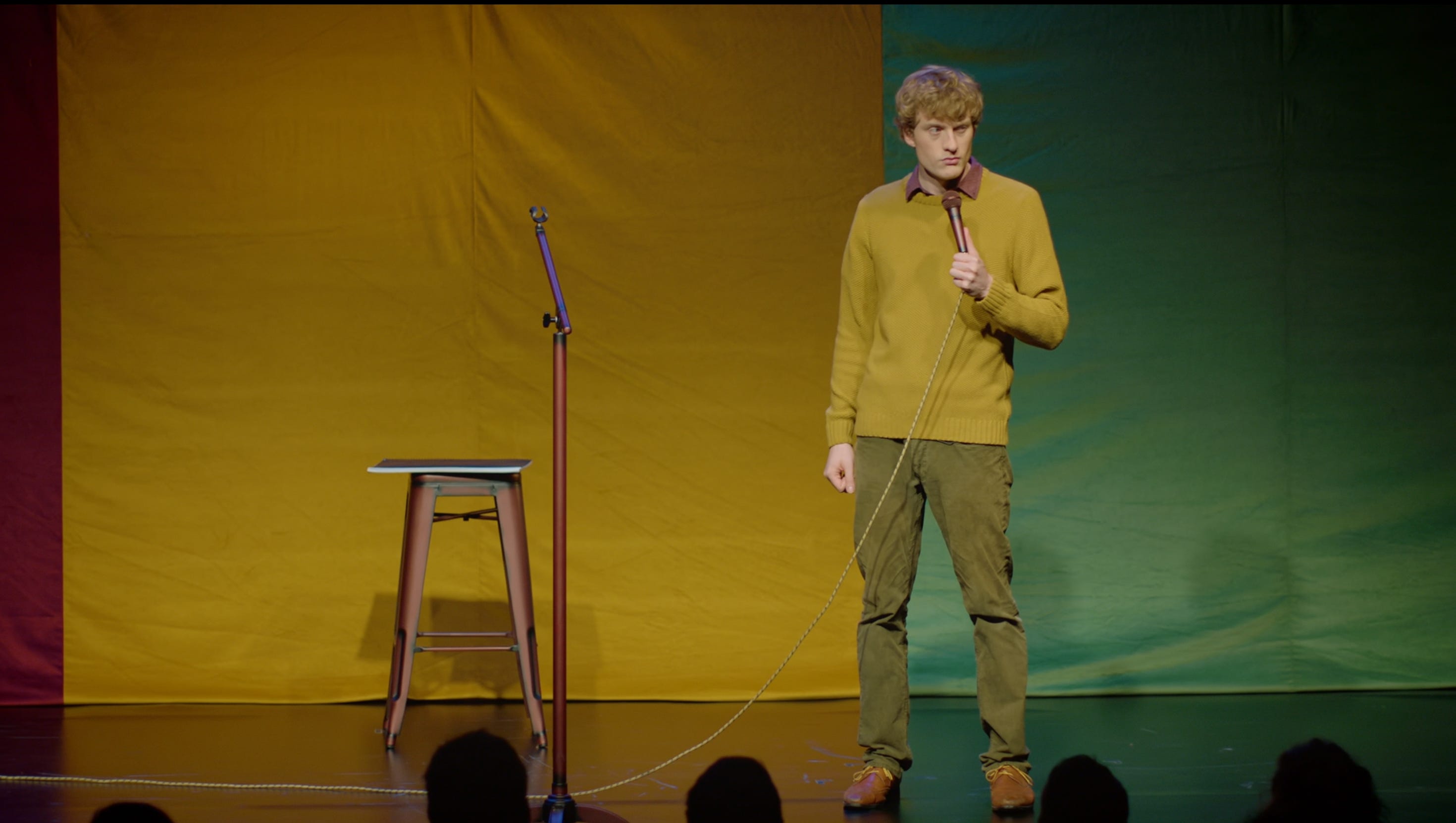
And then (spoiler number 2 coming up) in the fourth and final set, “Recap,” Acaster weaves everything together. He signals this immediately, with his attire. In the previous sets, he’s worn single colors, blending into the background. Now, the backdrop is yellow, red, and green—and so is he.
The series ends with him walking offstage and reentering to the set of episode 1 again—a spiral fully looping back in on itself.
Where spirals go
When we use the verb spiraling, we often mean it negatively—spinning in place, fixating on a problem, caught up in bad thought or feeling.
And there’s a bit of that in the kind of spiraling of Acaster’s sets, in remaining preoccupied with a past experience and continually returning to it.
But all of these negative aspects of spiral narration—the static nature of a spiral, the repetition and the way it forces things into pattern, so that everything looks like the problem, the cyclical loops it entails—have a positive side as well. Rephrased just slightly, they sound like a seemingly opposite type of thought pattern: meditation. To be still and repeat and feel everything cycle back in on itself. Turned in this way, it’s often a narrative that leads to deeper understanding.
And this is, in the end, the most satisfying part of Acaster’s specials, of seeing everything come into a sort of sense at the end, when the pieces feel, for the most part, so chaotically random.
The act of spiraling, in this case, is not just to spin and spin and spin and go nowhere. It’s stand-up comedy, so the final scenes are funny and ridiculous—Acaster plays Auld Lang Syne on a slide whistle in one; he enacts a Christingle ceremony in another and then eats the orange—but also, by the end, the stories have gathered, if not to realizations, than to clearer sets of questions.
To go back through the door at the end and reemerge at the beginning, to start the process all over: Is the final scene a rebirth or a sense that there is no way out? Hope or despair? Both?
What I love most about comedy is that you get to ask questions like this while laughing. The movement into feeling is surprising and quick, and you’re not always sure how you got there. I like a lot of different comics, but my favorites are able to have these deeply human moments alongside the incredibly silly ones.
When I wrote this post, earlier last month, we had just started the second semester here at the Institute. I had to keep reminding myself that I was only halfway through my time here—because I felt as though it was already over. As other scholars arrived, scheduled to stay a few months or the semester, and I had to tell myself: This is the whole of their time here. You can pretend that this is the start of your time here too.
For our first seminar, we walked up a winding staircase to the art studio where one of my neighbors had been working on a series of paintings. All of her pieces are in progress; the series she’s working on is incomplete, so I’ll be vague on the details. I’ll say only this:
We started our time with some meditation on the paintings, and I found myself standing in front of a series of spirals. Spirals embedded in bark and the throat of a woman and the base sprout that an egg grew out of. I’d been to the studio before and seen most of these paintings, last semester, but coming back to them that day, I saw them differently.
Looking at the paintings, seeing those spirals, I thought about woundedness and healing, about the clarity that comes out of chaos, about the cyclical nature of most things. I’ve already been here, I’ve thought, more than once, during the post-concussion recovery. As though my life were a television show and the writers had gotten lazy, too many storylines that resembled one another, too many arcs that looked the same. I’ve already realized these things. But you have a realization and you realize it again, differently, later. You are well and then not and then maybe well again. Spiraling, in this sense, is a searching. Coming back and seeing again. And again.
There’s not always humor in that, but sometimes there is—in the absurdity of repetition or the ridiculous nature of some circumstances. The surprise in the source of realization, its suddenness or strangeness when it comes.
Or, sometimes, this is simply the talent of the comic or the artist: to give form and shape to experience, to make us laugh and feel deeply at once, to take what was once painful and turn it into something else.
Brief note: One of my favorite Substacks on the creative life is by a Notre Dame classmate pursuing comedy in Berlin. (I don’t know her personally, but we have some mutual friends.) She’s doing a benefit show next week for mutual aid in Minnesota. Here are links to her Substack and (on the off chance anyone is in Gemany!) the show.
Allison, Jane. Meander, Spiral, Explode: Design and Pattern in Narrative. Catapult, 2019, p. 143-144.
qtd. in Allison, p. 118
p. 156